Harmony Evans –
Mountain:
I hike to the top of the mountain alone. In the distance, the sun’s orange glow melts into the night blue sky as it crests over far-off hills. The view justifies waking up laughably early on a Saturday.
I sit on a log near the mountain’s edge, where the rock drops off and gives way to a sea of pine trees and light fog. There’s nobody around for miles, as far as I know. It’s just me and the critters lurking in the woods that are here to see the sunrise and breathe in the spring air tinged with the scent of petrichor. A pair of squirrels chase each other through the underbrush near the edge of the path I have just traversed. Above the treetops in front of me, a flock of unidentifiable dark birds flit about, silhouetting against the lightening horizon. Their chirps break the quiet, echoing through the calm.
Glancing at my watch, I confirm that, as of eight minutes ago, I am now twenty-two years old.
Birds:
The other girls at my high school don’t bother me, but they also don’t talk to me much. I don’t blame them. I’m not much for conversation. Sometimes I wish I had been granted the gift of gab, but even if I could string together more than two sentences without stuttering, I still don’t think I would talk very often. It feels like everyone but me has a script to follow, telling them what to say and when to say it. I’m just not sure I understand other people.
Birds, on the other hand, are very simple. They fly, sing, eat, sleep, and mate. If they want something, or need to go somewhere, they do it. No beating around the bush. No rules to follow. They live quite nice lives, I think.
My parents always lament over the fact that they raised me in the middle of nowhere. But rural Vermont has a plethora of native birds that I am grateful to observe. Woodpeckers, red-tailed hawks, robins, northern cardinals, finches, sparrows, mourning doves, bluebirds. Among many others. There is a bird feeder in our backyard I have been watching diligently for the past few years, noting down new species in my life list when they visit.
Today, I see two crows circling each other high above our town in some sort of dance. I wonder if they’re from the same flock, or if they’re just meeting for the first time.
Trees:
By age nine, it is clear to the other kids I don’t exactly fit into their friend groups. To their credit, they did try to include me in classroom activities and recess games for the first few years of school. I was always invited to join their fun. But while the rest of them played hopscotch or talked on the swing sets, I chose to sit beneath the trees on the edge of the yard and read. Eventually they stopped asking.
The books I read are about kids wishing for adventure, and worrying about school, and arguing with their parents. The kids in these stories are a lot like me. Maybe they’re a lot like my classmates, too. With similar lives and problems and dreams.
I’m sure every new batch of third graders that play in this schoolyard look the same to the teachers, and that the teachers look the same to the schoolyard trees that have stood sturdy for decades.
I wonder how many little girls have spent recess sitting beneath the tree I’m under now.
Flowers:
My fifth-grade teacher always has fresh flowers displayed in a vase on her desk. When they begin to wilt, they will be replaced by new, healthy ones the next day. The flowers are different every time. Red roses, pink tulips, white lilies, cream carnations. Gifts from students, perhaps? Her husband? Or maybe she kneels in the dirt and clips them herself, every week, to place in the clear glass vase full of water for everyone to see. I hope they are gifts. It would be a shame for her to have to dirty her nice skirts and dresses in garden grime.
I would like to be a person who receives flowers every week. To display on my desk. To let everyone know that I am the type of person that is gifted flowers for no reason at all. Just because someone saw flowers and thought to give them to me.
The next time my teacher’s flowers begin to wilt, I think I will bring her some daisies.
Ocean:
I like to visit the ocean in early winter, when nobody else is around. Obviously, the weather in the summer is better suited for swimming, beach combing, or suntanning. And you don’t get as much of that salt-tinged breeze wafting off the waves when the air is already chilled. But snowy sands generally don’t bring in tourists, so I plan my beach trips in November or December, just before it gets cold enough for any of the seawater to ice over.
Besides, the waves don’t mind what season it is. They’re always crashing against the shore, kissing the sands. I like to listen to the monotonous slosh-and-recede of the water while reading or wandering the beach. Sometimes I’ll bring a camera. Vermont doesn’t have a coastline, so I’m glad to be attending college in Maine, where I can waste an afternoon staring at the never-ending expanse of deep blue whenever I want.
If no one passes by walking their dog, I can spend an entire day, sunrise to sunset, without seeing a single person. Even the boats that dot the horizon in the summer are absent. But I know that across the sea, thousands of miles away, sits the rest of the world. People I will never meet, lives I will never live, persisting. Completely unaware someone from New England is thinking about them.
Sunset:
The day I graduate high school, I sit on the back porch alone to watch the sunset. I’m meant to attend college in the fall, to study wildlife ecology. I think I’d like to work in conservation, to protect the wilderness I love. So little kids can keep playing in streams and feeding ducks at the pond. But I’m not sure yet. All I know is that plants and animals make more sense than people, and if I can spend the rest of my life in the woods then I’ll be happy.
The sun has been setting later in the evening, which I am glad about. I love all the seasons for their particular charms, but I’ll admit that I’m not really a fan of how short the days are in winter. One of my favorite days every year is the first warm, sunny afternoon in spring, when people gather on the school lawns and children laugh in the parks. And by summer, the sun is out until eight o’clock.
The only one of my classmates to say goodbye was a girl from my kindergarten class I hadn’t spoken to since elementary school. I was so surprised I can’t even recall if I said something back. I’ll never see her again, anyway, so I guess it doesn’t matter.
Bird (Again):
Biking home from the park over summer break the year after seventh grade, I stop to rest on the side of the trail. Making my way over to the sitting area, I notice what appears to be a small red-winged blackbird lyingamong a scattering of leaves on the ground. Dead, by the looks of it. And for quite some time. Its chest is concave, small bones sticking out among the feathers, and its glassy eyes are unseeing. One of the wings is bent forward, exposing the blood-orange of its shoulder.
I wonder how it died. How long it has been here, undisturbed. If it has a brood of chicks waiting in a nest somewhere, hoping for its return.
It feels wrong, somehow, to just leave this tiny body to lie unceremoniously in the dirt. With my bare hands, I begin scooping damp soil to create a hole half a foot deep. Using a handkerchief from my backpack, I scoop up the lifeless creature and rest it in the makeshift grave, cover the body with the cloth, and bury the bird in the earth.
Mountain (Again):
I stay up on the mountain above the rest of the world until late morning. My stomach has begun growling, so I decide I’ve inhaled enough forest air for one day. Besides, I know my mother has some family gathering planned for later, and she’d be upset if I arrived late.
I’m graduating college soon, which either means a job or more school. I haven’t decided yet. But I know that I’d like to do what I can to give back to the planet I live on. However that may be.
A few days ago, some classmates and I held an event at the park for the kids in town. The frogs have started to come out of hibernation, so we gave them a lesson on frog behavior and let them watch the pond. I didn’tspeak much, but one little girl looked up at me with big shimmering eyes after seeing a tiny green frog hop onto a log in front of us, so I think I did enough.
Moon:
In my environmental science and geography courses, we talk a lot about time. Longevity. The Earth is 4.54 billion years old. Modern Homo sapiens have been around for about 200,000 years or so, which, in the grand scheme of things, is nothing. But on a human scale, even just one year is pretty long. To think that thousands of years ago, people like me were walking on this same ground. It’s hard to wrap my brain around.
I always meant to take an anthropology class. I never got around to it.
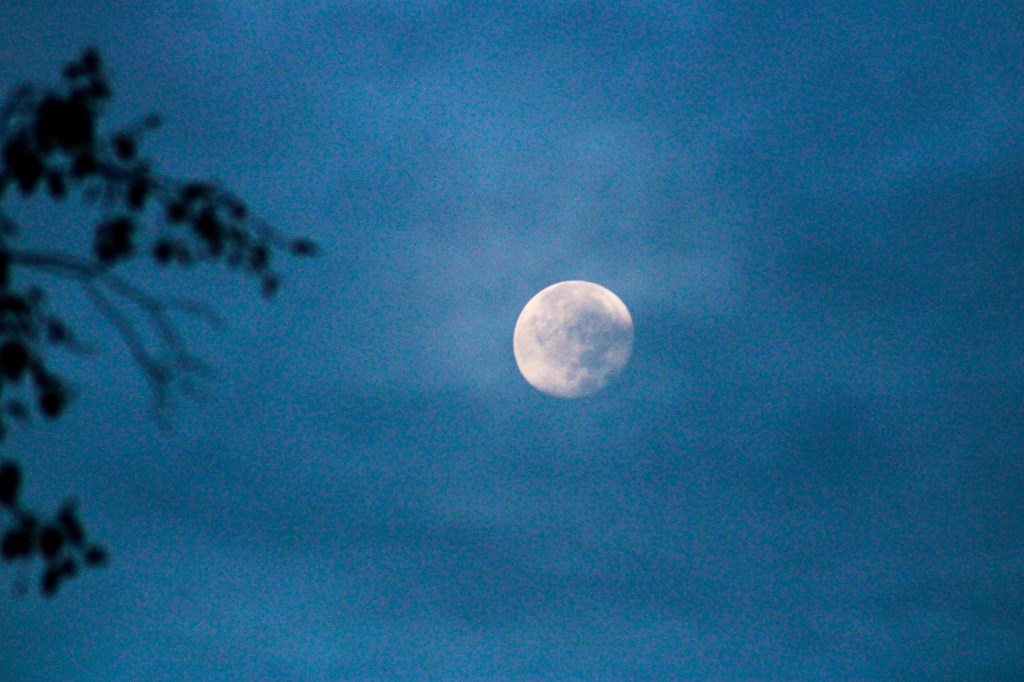
The moon is just about as old as our planet, probably formed from the debris of a small planetary body colliding with Earth. Which means it has been around for the entire duration of human history. The moon I’mlooking at tonight is the same moon the first humans in Ethiopia watched, and the same moon the Mesopotamians saw, and the same moon the Apollo 11 crew landed on, and the same moon someone in Ecuador took a picture of yesterday.
We are all connected by this celestial body. The moon is the moon is the moon.
 Purple Finch Press
Leave a comment